
Employees’ Descriptions and Management of Power-Laden Stigma in Sexual and Reproductive Healthcare at Planned Parenthood
By Rikki A. Roscoe

Project Abstract
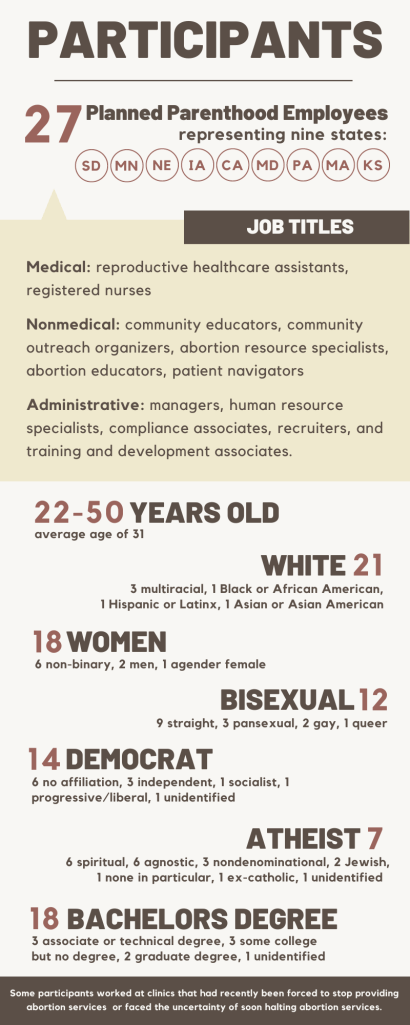
Despite providing vital sexual and reproductive healthcare for over 100 years, the U.S. Planned Parenthood (PP) organization has remained highly contested, making it difficult for the organization to attain its mission of providing “care, no matter what.” The current study took a critical-interpretive health communication approach to examine how healthcare employees experienced and managed power-laden stigma related to working in a core stigmatized organization – PP. Data was collected through in-depth interviews with 27 U.S. PP employees approximately one month after the fall of Roe v. Wade and analyzed using the phronetic iterative approach. Ultimately, PP employees described four stigmatizing constructions of the organization that impacted employees and patients: 1) PP as abortion provider, 2) PP as white supremacist, 3) PP as covert capitalist, and 4) PP as shallow activist. PP employees’ management of multiple power-laden stigmas depended on whether their stigmatized identity was discredited or discreditable (Goffman, 1963), that is, known or unknown. Employees were discredited in the workplace, where their stigma management responses were often impacted by organizational policy or the need to remain professional in patient-provider interactions. Employees were discreditable outside of the workplace. In this case, employees engaged in a stigma appraisal process, a new concept where a stigmatized individual considers several internal and external factors in deciding whether to disclose their stigmatized identity. In addition, employees managed stigmatizing discourses and structural stigma. This study contributes to communication scholarship by advancing stigma management theorizing and developing new stigma concepts, including stigma appraisal, synecdochical stigma, and the abortion stigma hierarchy. Further, the results have the ability to inform destigmatizing campaigns, organizational practices, and employee training that can improve conditions for employees working in stigmatized organizations and improve patient-provider communication surrounding stigmatized healthcare. Ideally, these contributions can ensure that PP not only provides “care, no matter what” but effective care.
RQ1
How do Planned Parenthood employees describe the multiple power-laden stigmas surrounding the Planned Parenthood organization?
I. Planned Parenthood as Abortion Provider
“In most people’s minds, when you think of Planned Parenthood, you think of abortion.” – Stella, Registered Nurse
II. Planned Parenthood as White Supremacist
“Planned Parenthood has a really, excuse my French, shitty history. It started out with Margaret Sanger. And there was definitely a huge amount of eugenics in Planned Parenthood when it first started.” – Kai, Community Educator
III. Planned Parenthood as Covert Capitalist
“Some of the things that Planned Parenthood does really suck and are kind of fucked up… like, very profit-centered and not, like, patient-centered.” – Olivia, Training and Development Specialist
IV. Planned Parenthood as Shallow Activist
“I think that Planned Parenthood touts itself on being very inclusive… being very, like, we’re for the gays except for when it comes to actual, tangible actions. We’re not quite there. We’re not doing everything that we possibly can be doing.” – Brynn, Abortion Educator
RQ2
How do Planned Parenthood employees manage the multiple power-laden stigmas surrounding the Planned Parenthood organization?
I. Discredited Stigma Management
PP employees were discredited in the workplace because their stigmatized work identity was displayed. Here, employees’ stigma management strategies were primarily dictated by workplace policy and the need to remain professional when interacting with patients.
II. Discreditable Stigma Management
PP employees were discreditable outside of the workplace because their stigmatized work identity was often unknown. In discreditable situations, PP employees: 1) engaged in a stigma appraisal process where they considered several internal and external factors in deciding whether to disclose their stigmatized work identity, 2) faced forced disclosure regardless of whether they wanted to disclose, and/or 3) chose to ignore and display their stigmatized status without concern of the consequences.
III. Communicatively Managing Stigmatizing Discourses
Participants responded to stigmatizing discourses by 1) framing abortion as basic healthcare, 2) highlighting PP’s helpful and life-saving services, and 3) framing the stigmatizers as hypocritical.
IV. Structural Stigma Management
In addressing structural stigma, participants 1) sought to find loopholes in state policy, 2) provided scarce resources to underserved communities, including education and financial assistance for health services, 3) individualized patient care by emphasizing equity over equality and centering co-cultural members and communities, and 4) enacted overt resistance to organizational policies by attempting to unionize.
 RIKKI A. ROSCOE, PH.D.